Display SSRS RDL report in Bold Reports® Angular Report Viewer (pnpm)
This guide explains how to create an Angular reporting application using pnpm to display an existing SSRS RDL report in the Bold Reports® Angular Report Viewer without using a Report Server.
This guide applies to Angular version
17.xand above. If you are using an earlier version, please refer to the Getting Started for Earlier Version.
In Angular version
20.xand above, certain filenames have been updated. For example, the file previously namedapp.component.tsis now renamed toapp.ts.
To get started quickly with Report Viewer, you can check this video:
Prerequisites
Before you begin, make sure your development environment includes the following:
- Node JS (
version 20.x or 22.x and above) Version Compatibility pnpm(v8.xor higher recommended)
Install the Angular CLI (global)
Angular provides the easiest way to set Angular CLI projects using the Angular CLI tool. To install the CLI application globally on your machine, run the following command in the Command Prompt.
pnpm add -g @angular/cli@latestTo learn more about
angular-clicommands, click here.
Create a new application
To create a new Angular application, run the following command in the Command Prompt:
ng new project-name --package-manager=pnpm

E.g : ng new reportviewerapp --package-manager=pnpm
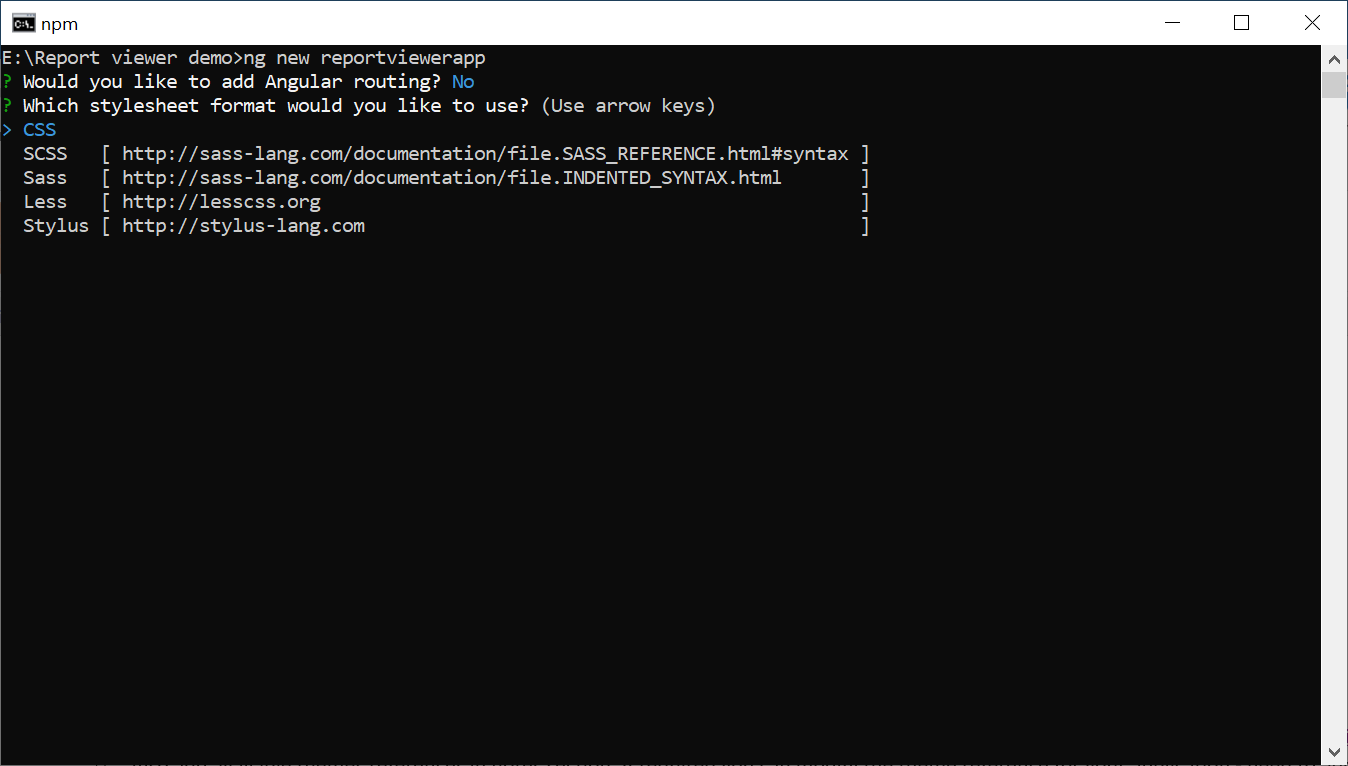
The ng new command prompts you for information about features to include in the initial app project. Accept the defaults by pressing the Enter or Return key.
Note: The above command creates a new Angular application and configures it to use
pnpm(instead of npm) as the package manager for installing and managing dependencies.
Configure the Bold Report Viewer in Angular CLI
Reporting packages are available from NPM and work the same with pnpm.
-
To configure the Report Viewer component, change the directory to your application’s root folder.
cd project-name E.g: cd reportviewerapp -
Run the following commands to install the Bold Reports® Angular library.
pnpm add @boldreports/angular-reporting-components --save-dev -
Install the typings dependencies
jquery,types/jqueryandboldreports/types.pnpm add --save-dev jquery pnpm add --save-dev @types/jquery pnpm add --save-dev @boldreports/types pnpm add @boldreports/javascript-reporting-controls -
Refer the jQuery script file (
jquery.js) as given in theangular.jsonfile within theprojectname > scriptssection (For example,reportviewerapp > scripts).{ "$schema": "./node_modules/@angular/cli/lib/config/schema.json", "projects": { "reportviewerapp": { "root": "src", "outDir": "dist", . . . "styles": [ "src/styles.css" ], "scripts": [ "./node_modules/jquery/dist/jquery.js" ], . . . } } } -
Add the typings
jqueryandreports.allto thetsconfig.app.jsonfile:{ ... "compilerOptions": { ... "baseUrl": "", "types": [ "jquery", "reports.all" ] }, ... } -
Register
@bold-reports/typesundertypeRootsin thetsconfig.jsonfile.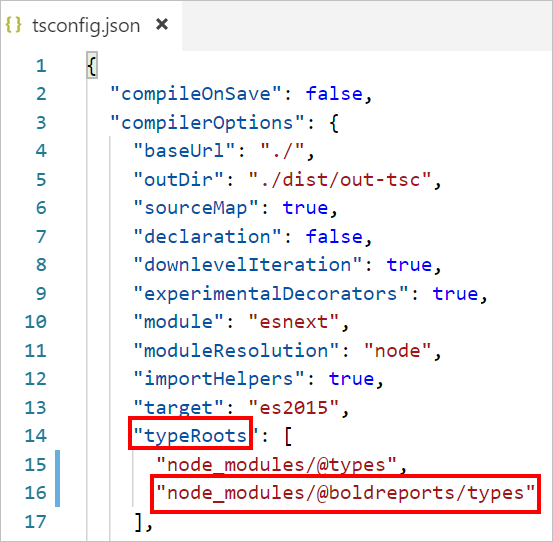
Adding CSS reference
Add the Report Viewer component style (bold.report-viewer.min.css) as given in the angular.json file within the projectname > styles section (For example, reportviewerapp > styles).
{
  "$schema": "./node_modules/@angular/cli/lib/config/schema.json",
  "projects": {
    "reportviewerapp": {
      "root": "src",
      "outDir": "dist",
      . . .
      "styles": [
        "styles.css",
        "./node_modules/@boldreports/javascript-reporting-controls/Content/v2.0/tailwind-light/bold.report-viewer.min.css"
      ],
      "scripts": [
        "./node_modules/jquery/dist/jquery.js"
      ],
      . . .
    }
  }
}
In the previous code, the
tailwind-lighttheme is used. You can modify the theme based on your application, refer the following syntax:./node_modules/@boldreports/javascript-reporting-controls/Content/v2.0/[theme-name]/bold.report-viewer.min.css
Adding Report Viewer component
To add the Report Viewer component, refer to the following steps:
-
Open the
app.tsorapp.component.tsfile. -
You can replace the following code snippet in the
app.tsorapp.component.tsfile.import { Component } from '@angular/core'; import { CommonModule } from '@angular/common'; import { BoldReportViewerModule } from '@boldreports/angular-reporting-components'; // data-visualization import '@boldreports/javascript-reporting-controls/Scripts/v2.0/common/bold.reports.common.min'; import '@boldreports/javascript-reporting-controls/Scripts/v2.0/common/bold.reports.widgets.min'; // Report viewer import '@boldreports/javascript-reporting-controls/Scripts/v2.0/bold.report-viewer.min'; @Component({ selector: 'app-root', imports: [CommonModule, BoldReportViewerModule], templateUrl: './app.html', // or app.component.html styleUrls: ['./app.css'] // or app.component.css }) export class AppComponent { public reportServiceUrl: string; public reportPath: string; constructor() { // Initialize the Report Viewer properties here. } } -
Open the
app.htmlorapp.component.htmlfile and initialize the Report Viewer. -
You can replace the following code snippet in the
app.htmlorapp.component.htmlfile.<bold-reportviewer id="reportViewer_Control" style="width: 100%;height: 950px"> </bold-reportviewer>
Create Web API service
The Report Viewer requires a Web API service to process the report files. You can skip this step and use the online Web API services to preview the already available reports or you should create any one of the following Web API services:
If you are looking to load the report directly from the SQL Server Reporting Services (SSRS), then you can skip the following steps and move to the SSRS Report.
Adding already created report
If you have created a new service, you can add the reports from the Bold Reports® installation location. For more information, refer to the samples and demos section.
-
Create a folder
Resourcesin your Web API application to store the RDL reports and add already created reports to it. -
Add already created reports to the newly created folder.
In this tutorial, the
sales-order-detail.rdlreport is used, and it can be downloaded at this link.
Refer to the create RDL report section for creating new reports.
Set report path and Web API service
To set the report path and the Web API service, open the app.ts or app.component.ts file and add the codes as shown in the constructor.
    import { Component } from '@angular/core';
    import { CommonModule } from '@angular/common';
    import { BoldReportViewerModule } from '@boldreports/angular-reporting-components';
    // data-visualization
    import '@boldreports/javascript-reporting-controls/Scripts/v2.0/common/bold.reports.common.min';
    import '@boldreports/javascript-reporting-controls/Scripts/v2.0/common/bold.reports.widgets.min';
    // Report viewer
    import '@boldreports/javascript-reporting-controls/Scripts/v2.0/bold.report-viewer.min';

    @Component({
      selector: 'app-root',
      imports: [CommonModule, BoldReportViewerModule],
      templateUrl: './app.html', // or app.component.html
      styleUrls: ['./app.css'] // or app.component.css
    })
    export class AppComponent {
      public reportServiceUrl: string;
      public reportPath: string;

      constructor() {
        this.reportServiceUrl = 'https://demos.boldreports.com/services/api/ReportViewer';
        this.reportPath = '~/Resources/docs/sales-order-detail.rdl';
      }
    }
In the above code, the
reportServiceUrlis used from online URL. You can host the Bold Reports® service at any Azure, AWS, or own domain URL and use it in the Report Viewer. You can view the already created Web API service from the Reporting Service git hub location.
Open the app.html or app.component.html to set the reportPath and reportServiceUrl properties of the Report Viewer as in the following.
<bold-reportviewer id="reportViewer_Control" [reportServiceUrl] = "ServiceUrl" [reportPath] = "reportPath" style="width: 100%;height: 950px">
</bold-reportviewer>
Serve the application
To serve the application, follow these steps:
-
Navigate to the root of the application and run the application using the following command.
ng serve -
Navigate to the appropriate port
http://localhost:4200in the browser.
Note: You can refer to our feature tour page for the Angular Report Viewer to see its innovative features. Additionally, you can view our Angular Report Viewer examples which demonstrate the rendering of SSRS RDLC and RDL reports.
See Also
Set data source credential for shared data sources