Data-Driven Schedule
Data-Driven / Burst Scheduling allows you to automate the generation and delivery of personalized reports based on records available in a dataset. The scheduler processes each row in the selected dataset and generates an individual report using the values configured for that row.
This feature helps organizations distribute reports to multiple recipients with different parameter values, export formats, delivery methods, and report settings without creating multiple schedules manually.
NOTE: Data-Driven Scheduling is best suited for reports that contain parameters. The scheduler uses parameter values from each dataset row to generate personalized reports for different recipients.
Create a Data-Driven Schedule
To create a data-driven schedule, follow these steps:
-
Create a schedule from the context menu of the respective report by clicking the Schedule option.
-
Select Data-driven / Burst Schedule.
-
Choose the required Category and Report.
-
Enter a unique Schedule Name.
-
Click the
Nextbutton.
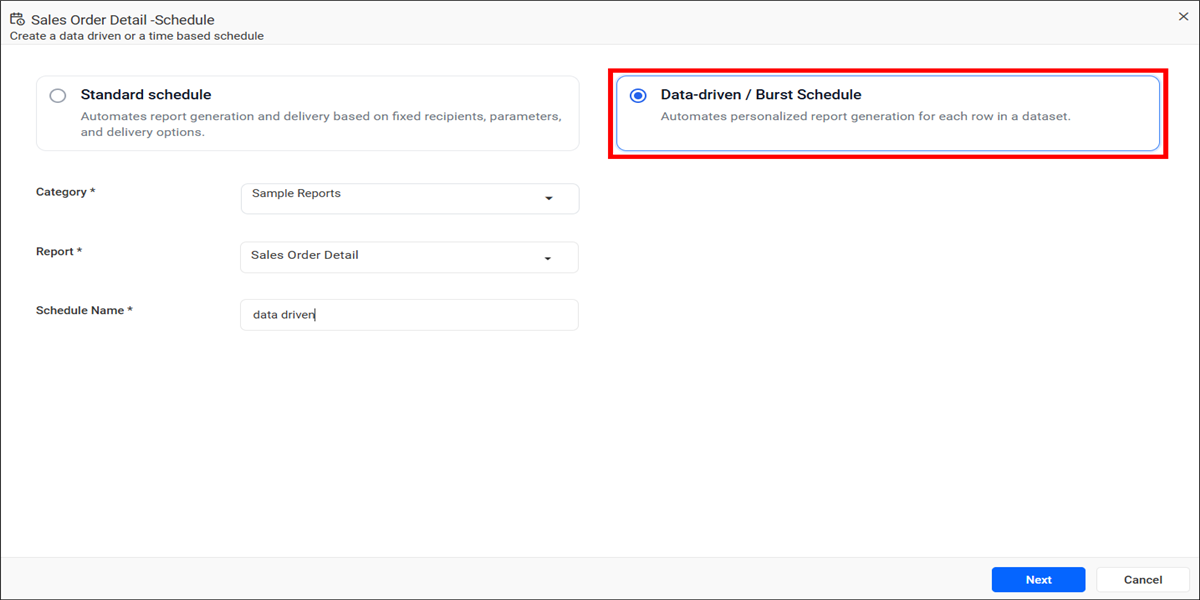
NOTE: Before creating a Data-Driven Schedule, create the required datasource and dataset in the Bold Reports® application. The dataset should contain the recipient information, report parameters, delivery settings, export options, and other schedule configuration values required for report generation. Only datasets associated with the selected datasource are available for selection during schedule configuration.
Select Datasource and Dataset
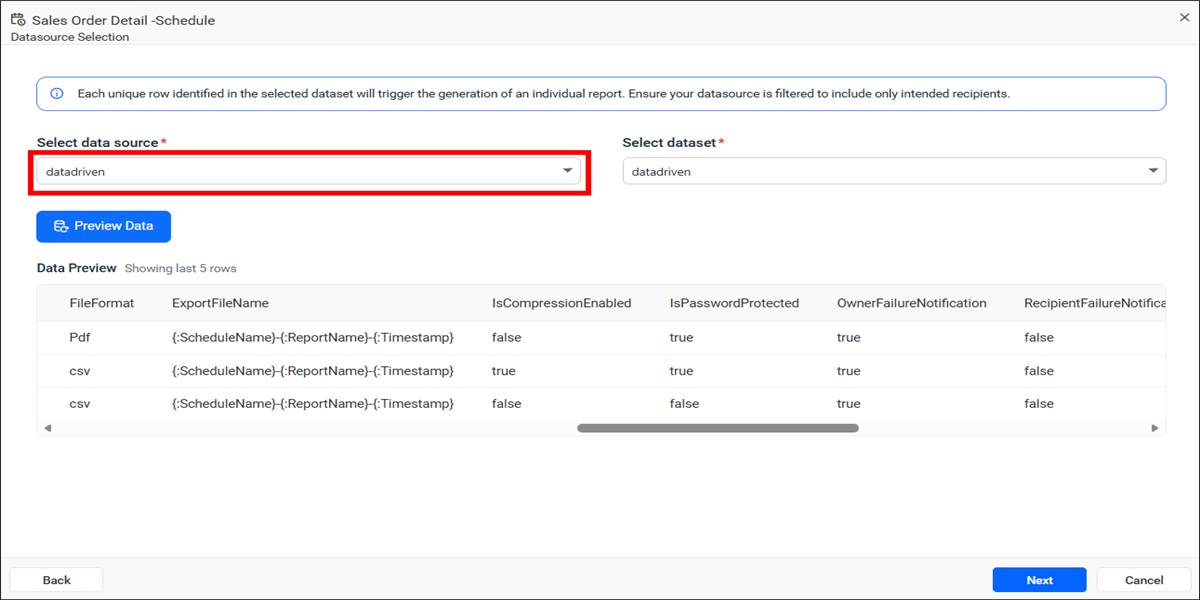
The datasource and dataset contain the records used to configure recipients, report parameters, delivery settings, export formats, and other schedule options.
Each row in the selected dataset represents an individual report generation request.
-
Select the required Data Source.
-
Select the required Dataset.
-
Click the
Preview Databutton to verify the dataset records. The preview displays the last 5 records from the selected dataset. -
Click the
Nextbutton to continue.
NOTE: Each unique row identified in the selected dataset triggers the generation of an individual report. Ensure that the dataset contains only the intended recipients and schedule configuration values.
Sample Dataset Record
The following sample JSON dataset record demonstrates values that can be used by a data-driven schedule.
{
    "ReportName": "SalesOrderDetail",
    "DeliveryType": "Mail",
    "Email": "sample@gmail",
    "IsNoDataEnabled": false,
    "EmailContent": "#### **Scheduled Report**\n\n\nHello {:FullName},\n\nPlease find attached the report you requested.\n\nThe schedule {:ScheduleName} has successfully exported the report. You can access it here: {:ReportLink}.\n\n\nRegards,\n\n{:OrganizationName}",
    "FileFormat": "Pdf",
    "ExportFileName": "{:ScheduleName}-{:ReportName}-{:Timestamp}",
    "IsCompressionEnabled": false,
    "IsPasswordProtected": true,
    "OwnerFailureNotification": true,
    "RecipientFailureNotification": false,
    "ReportPassword": "sample@123",
    "AttachmentName": "Report_1",
    "Order No": "SO50750",
    "SkipAttachment": true,
    "SkipMail": false,
    "Path": "Reports",
    "FileOverwrite": true,
    "MaxReportCount": 200,
    "NotifyRecipients": true
}
NOTE: The column names shown in the sample dataset (such as
FileFormat,Order No,Path, andAttachmentName) are provided for illustrative purposes only. You can use your own dataset column names and map them to the corresponding schedule properties during configuration. Ensure that the dataset contains the values required for report generation, delivery, and parameter mapping.
Configure Delivery Settings
After selecting the datasource and dataset, click the Next button to configure the report delivery settings.
The Delivery Settings page determines how the generated reports are delivered for each dataset row.
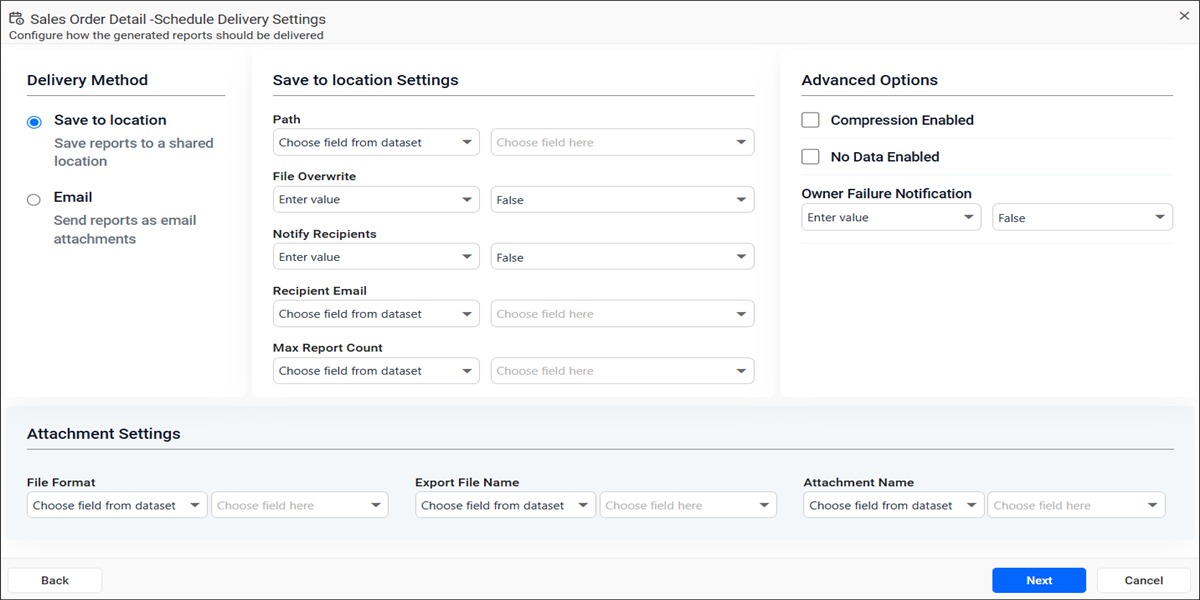
All schedule properties support two configuration methods:
- Choose field from dataset - Uses values from a dataset column during schedule execution.
- Enter value - Uses the same fixed value for all generated reports.
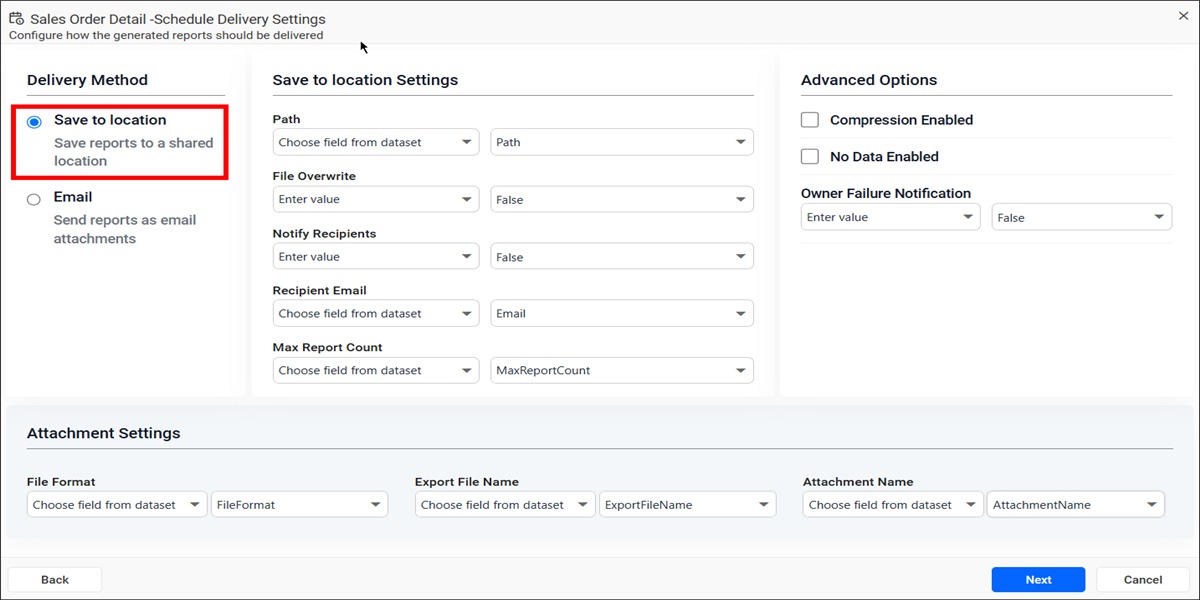
Save to Location
Select Save to Location to export generated reports to a shared location.
The following settings can be configured:
- Path - Specifies the folder where the generated reports are saved.
- File Overwrite - Determines whether existing files with the same name should be overwritten.
- Notify Recipients - Sends notifications after report generation.
- Recipient Email - Email address used for notifications.
- Max Report Count - Specifies the maximum number of reports that can be generated during a single schedule execution. Ensure that this value is greater than or equal to the number of records in the selected dataset; otherwise, some dataset records may not be processed.
Select Email to send generated reports as email attachments.
The following settings can be configured:
- Email Content - Custom email message sent to recipients.
- Recipient Email - Email address of the report recipient.
- Reply To - Email address used for reply responses.
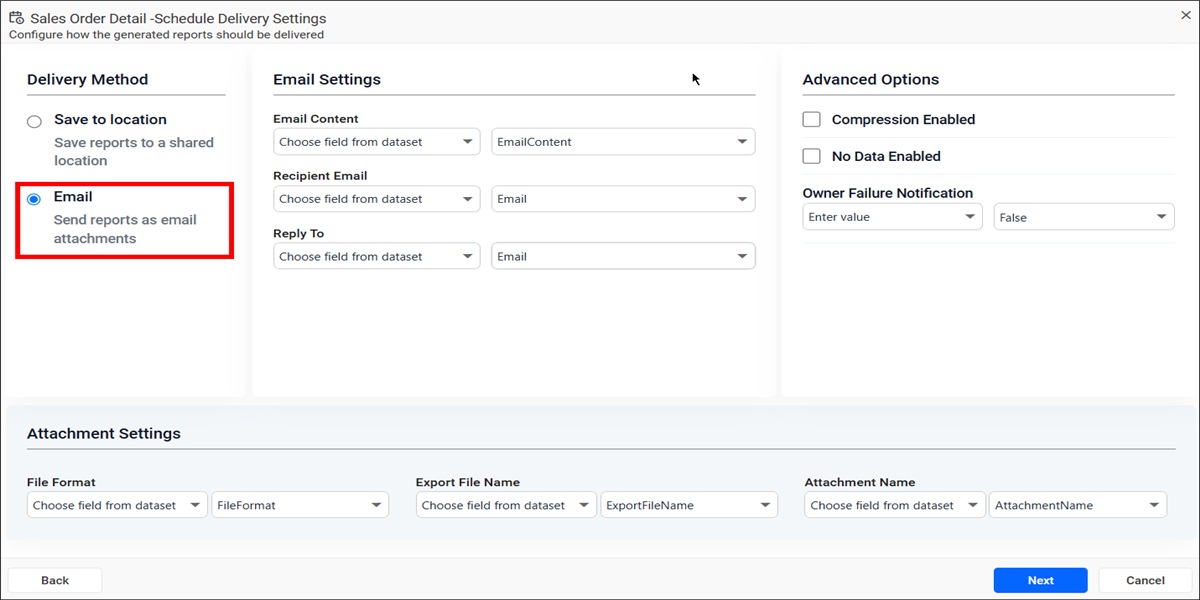
Attachment Settings
Attachment settings determine how the generated report files are created.
- File Format - Export format for the report. Supported formats include PDF, Excel, Word, HTML, PPT, CSV, and XML.
- Export File Name - Name of the generated file.
- Attachment Name - Name used for the email attachment.
Advanced Options
The following advanced settings are available:
- Compression Enabled - Compresses the exported report before delivery.
- No Data Enabled - Processes the schedule even when the report does not contain data.
- Skip Attachment - Sends the email notification without attaching the report when the generated report contains no data.
- Skip Mail - Does not send the email notification when the generated report contains no data.
- Owner Failure Notification - Sends notifications to the schedule owner when schedule execution fails.
The values for these settings can be retrieved directly from dataset columns or entered manually.
Click the Next button after configuring the delivery settings.
Configure Report Parameters
The Report Parameter Mapping page allows parameter values to be supplied dynamically for each dataset row.
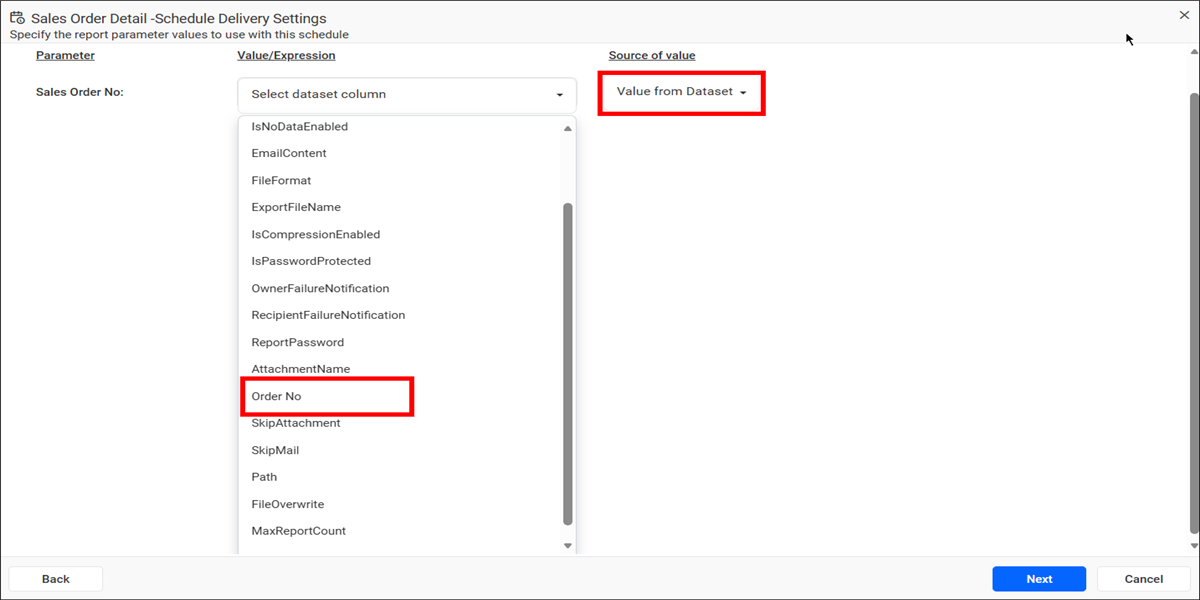
For each report parameter, select the source from the Source of value dropdown.
The following options are available:
- None – No value is assigned to the parameter.
- Use Default – Uses the default value configured in the report.
- Expression – Uses a custom expression.
- Value from Dataset – Retrieves the parameter value from a dataset column.
For each report parameter, you can select a dataset column from the Value/Expression dropdown when Value from Dataset is selected as the Source of value.
The selected dataset column is used to populate the corresponding report parameter during schedule execution.
For example, if the report contains a parameter named Sales Order No, you can map it to any suitable dataset column that contains the required parameter values, such as Order No.
| Dataset Column | Report Parameter |
|---|---|
| Order No | Sales Order No |
When the schedule executes, the scheduler retrieves the value from the selected dataset column and assigns it to the corresponding report parameter for each dataset record.
NOTE: Dataset column names are user-defined and can vary based on the datasource design. Any dataset column can be mapped to a report parameter as long as it contains the appropriate values required for report generation.
Example dataset rows:
| Order No |
|---|
| SO50750 |
| SO50751 |
| SO50752 |
In this example, the values from the Order No column are passed to the Sales Order No report parameter, resulting in the generation of three personalized report outputs.
Click the Next button after configuring the parameter mappings.
Configure Schedule Recurrence
The schedule recurrence settings are similar to those available in a standard schedule. Specify when and how often the data-driven schedule should run.
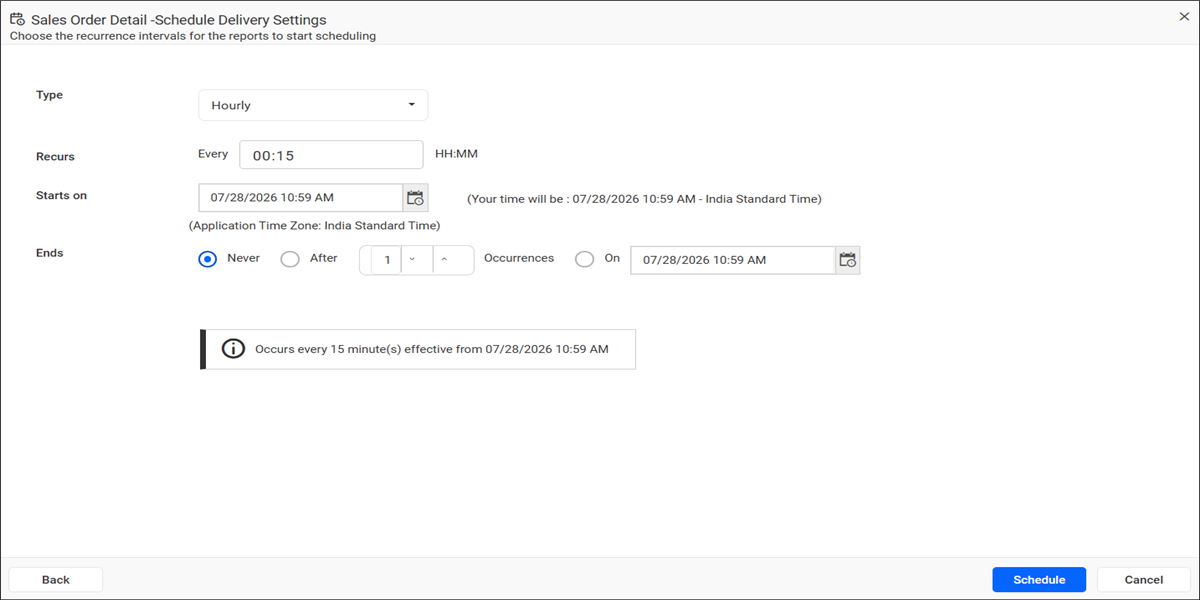
Configure the following schedule options:
- Type - Select the schedule frequency such as Hourly, Daily, Weekly, Monthly, or Yearly.
- Recurs - Defines how often the schedule should repeat.
- Starts On - Specifies the date and time when the schedule begins.
- Ends Never - Runs indefinitely until manually disabled.
- Ends After - Stops after a specified number of occurrences.
- Ends On - Stops on a specified date and time.
A schedule summary is displayed to help verify the configured recurrence pattern.
Click the Schedule button to create the data-driven schedule.
NOTE: During execution, the scheduler processes each dataset row individually. The report parameters, recipients, export settings, file names, and delivery configuration are dynamically generated from the corresponding dataset record.