Upgrading the Bold Reports® Linux package to the Latest Version
This section explains how to upgrade the Bold Reports® Linux package from any version to the latest version.
-
Register and download the latest Bold Reports® Linux package from the getting started guide.
-
Install the
pvtool by executing the following command:sudo apt-get install pv -
Install the python 3.9 or later by executing the following command:
Ubuntu Version:22.04 :
sudo apt-get install -y python3Ubuntu Version:20.04 :
sudo apt update && sudo apt install wget software-properties-common && sudo add-apt-repository ppa:deadsnakes/ppa && sudo apt update && sudo apt install python3.9 -
Install pip dependency packages for ETL service by running the following command:
sudo apt-get install python3-pip && sudo python3 -m pip install --upgrade pip && sudo pip install duckdb===1.1.2 dlt===0.4.12 pymysql pyodbc pg8000 poetry pandas===2.2.2 numpy===1.26.4 "dlt[parquet]" "dlt[filesystem]" -
Download the latest Bold Reports® Linux package by running the following command.
sudo wget {Bold Reports Linux package link} -
Extract the zip file.
sudo unzip {Bold Reports Linux package zip file} -
Change the directory to
BoldReports_EnterpriseReporting-Linuxby running the following command:cd BoldReports_EnterpriseReporting-Linux -
Execute the following command to deploy Bold Reports® on your Linux machine:
sudo bash install-boldreports.sh -i {upgrade} -u {user} -h {host URL}-
i: Installation type : Specifies whether it is a new or upgraded installation.
-
u: Specify the user or group that manages the service.
-
h: Domain or IP address of the machine with the HTTP protocol.
-
Example for upgrading the installation:
sudo bash install-boldreports.sh -i upgrade -u www-data -h http://linux.example.com-
Refer to the optional client libraries installation guide and install the optional client libraries after the installation is completed.
-
Now, you can open the host URL in the browser and use the latest features of Bold Reports®.
NOTE: The Bold Reports® Linux package backup file will be available in the following location: /var/www/
Upgrade breaking changes v3.x to latest
The below breaking changes are applicable only for upgrading the Bold Reports® application from version v3.x to latest version.
Automatic Nginx configuration:
-
If you preferred automatic Nginx configuration during the initial installation, the below prompt message will be displayed, and you can proceed with the installation by choosing Yes.

-
If you are choosing No, then please follow the below manual Nginx configuration step.
Manual Nginx configuration:
-
If you have manually configured Nginx during the initial installation, the below message will be displayed.

-
For manual Nginx configuration, modify the default Nginx configuration file in location
/etc/nginx/sites-available. Open it in a text editor and add the following code, like the below image.location /reporting/viewer { proxy_pass http://localhost:6554/reporting/viewer; proxy_http_version 1.1; proxy_set_header Upgrade $http_upgrade; proxy_set_header Connection keep-alive; proxy_set_header Host $host; proxy_cache_bypass $http_upgrade; proxy_set_header X-Forwarded-For $proxy_add_x_forwarded_for; proxy_set_header X-Forwarded-Proto $scheme; } location /etlservice/ { root /var/www/bold-services/application/etl/etlservice/wwwroot; proxy_pass http://localhost:6509/; proxy_http_version 1.1; proxy_set_header Upgrade $http_upgrade; proxy_set_header Connection "upgrade"; proxy_set_header Host $http_host; proxy_cache_bypass $http_upgrade; proxy_set_header X-Forwarded-For $proxy_add_x_forwarded_for; proxy_set_header X-Forwarded-Proto $scheme; } location /etlservice/_framework/blazor.server.js { root /var/www/bold-services/application/etl/etlservice/wwwroot; proxy_pass http://localhost:6509/_framework/blazor.server.js; proxy_http_version 1.1; proxy_set_header Upgrade $http_upgrade; proxy_set_header Connection "upgrade"; proxy_set_header Host $http_host; proxy_cache_bypass $http_upgrade; proxy_set_header X-Forwarded-For $proxy_add_x_forwarded_for; proxy_set_header X-Forwarded-Proto $scheme; }
Nginx configuration file code:
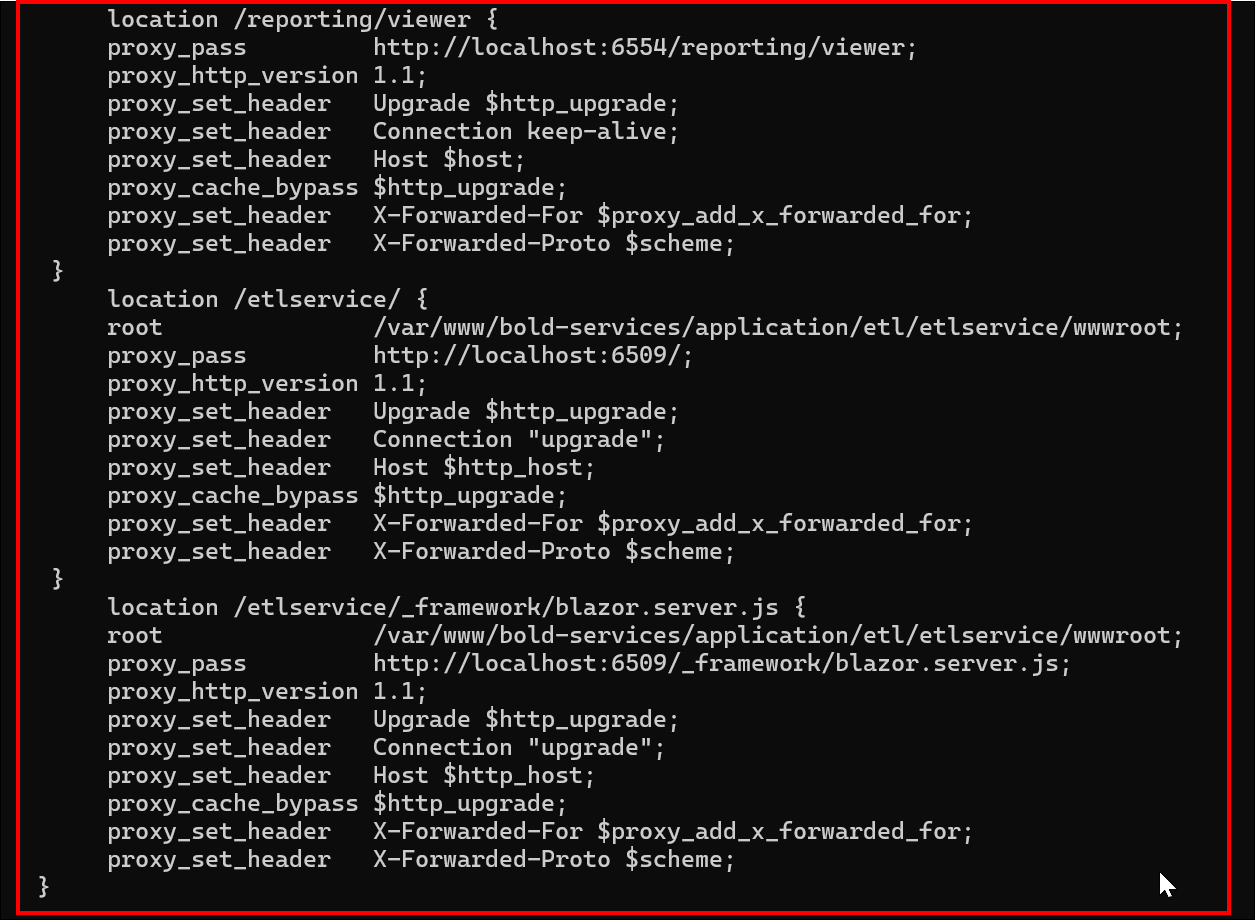
Once the Nginx configuration is updated, run sudo nginx -t to verify the syntax of the configuration files. If the configuration file test is successful, force Nginx to pick up the changes by running the sudo nginx -s reload.
Upgrade breaking changes v5.x to latest
The below breaking changes are applicable only for upgrading the Bold Reports® application from version v5.x to the latest version.
Automatic Nginx configuration:
-
If you preferred automatic Nginx configuration during the initial installation, the below prompt message will be displayed, and you can proceed with the installation by choosing
Yes.
-
If you choose
No, please follow the manual Nginx configuration steps below.
Manual Nginx configuration:
-
If you have manually configured Nginx during the initial installation, the following message will be displayed.

-
For manual Nginx configuration, modify the default Nginx configuration file located at
/etc/nginx/sites-available. Open it in a text editor and add the following code, as shown in the image below:location /etlservice/ { root /var/www/bold-services/application/etl/etlservice/wwwroot; proxy_pass http://localhost:6509/; proxy_http_version 1.1; proxy_set_header Upgrade $http_upgrade; proxy_set_header Connection "upgrade"; proxy_set_header Host $http_host; proxy_cache_bypass $http_upgrade; proxy_set_header X-Forwarded-For $proxy_add_x_forwarded_for; proxy_set_header X-Forwarded-Proto $scheme; } location /etlservice/_framework/blazor.server.js { root /var/www/bold-services/application/etl/etlservice/wwwroot; proxy_pass http://localhost:6509/_framework/blazor.server.js; proxy_http_version 1.1; proxy_set_header Upgrade $http_upgrade; proxy_set_header Connection "upgrade"; proxy_set_header Host $http_host; proxy_cache_bypass $http_upgrade; proxy_set_header X-Forwarded-For $proxy_add_x_forwarded_for; proxy_set_header X-Forwarded-Proto $scheme; }
Nginx configuration file code:
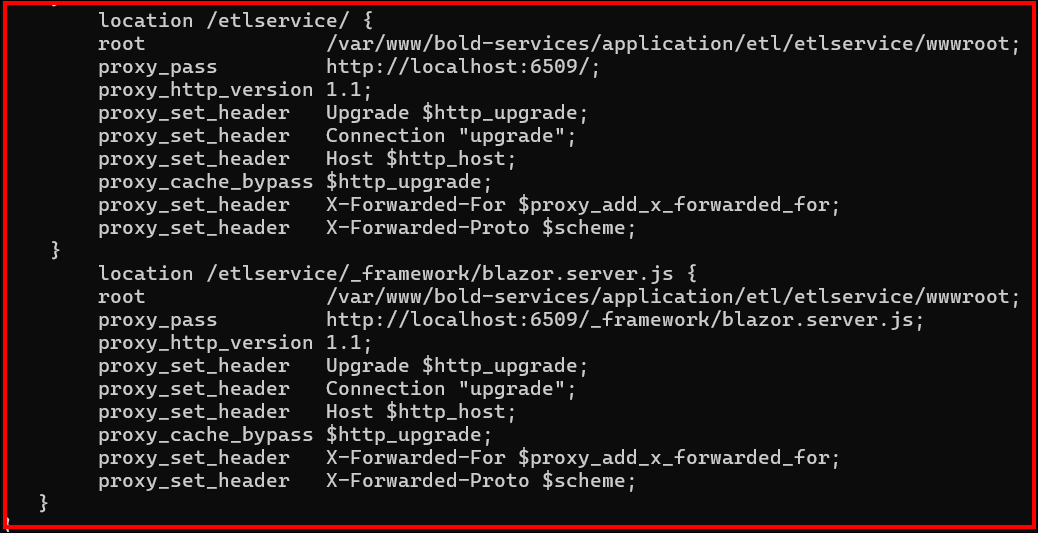
Once the Nginx configuration is updated, run sudo nginx -t to verify the syntax of the configuration files. If the configuration file test is successful, force Nginx to pick up the changes by running sudo nginx -s reload.
Upgrade Failure Notification
During an application upgrade, if a database script execution fails, the upgrade process continues without interrupting access to existing reports. In such cases, a notification banner is displayed indicating that the upgrade is still in progress and that some administrative actions may be temporarily unavailable until the issue is resolved.
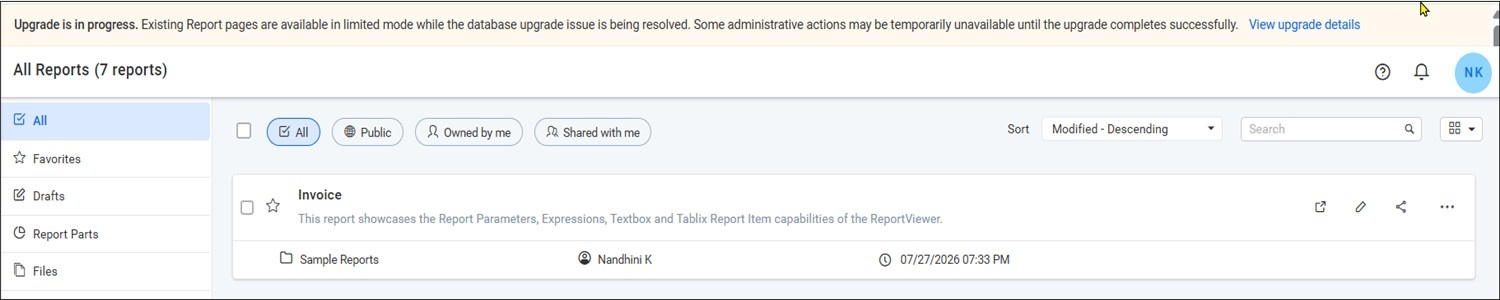
Click View upgrade details to view information about the upgrade failure, including the upgrade status, database provider, version details, failed script information, and error message.
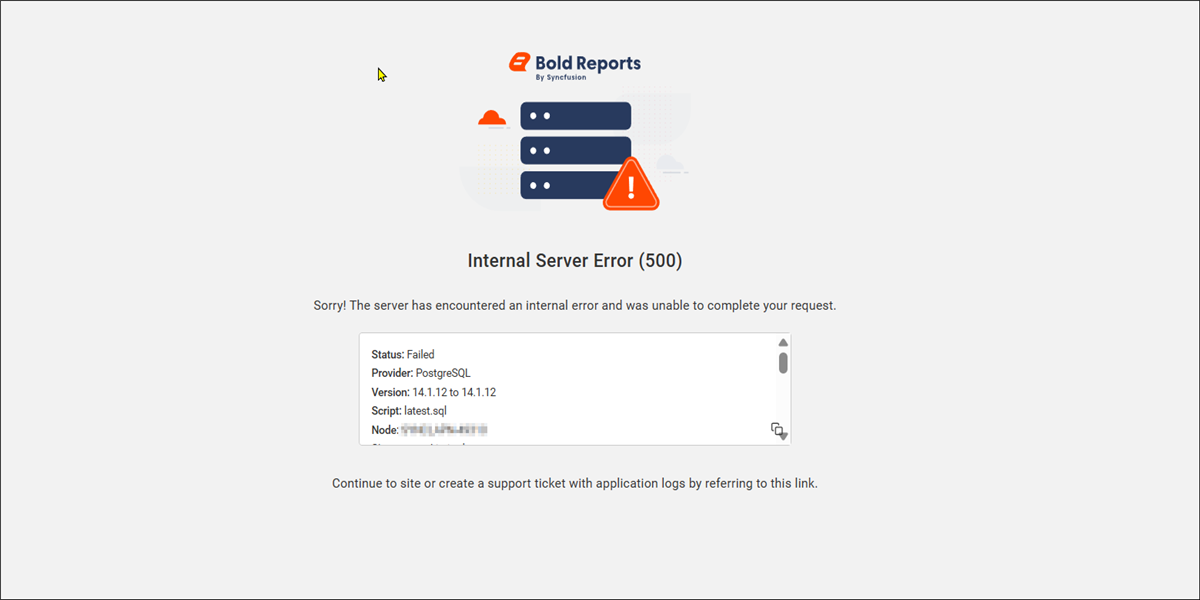
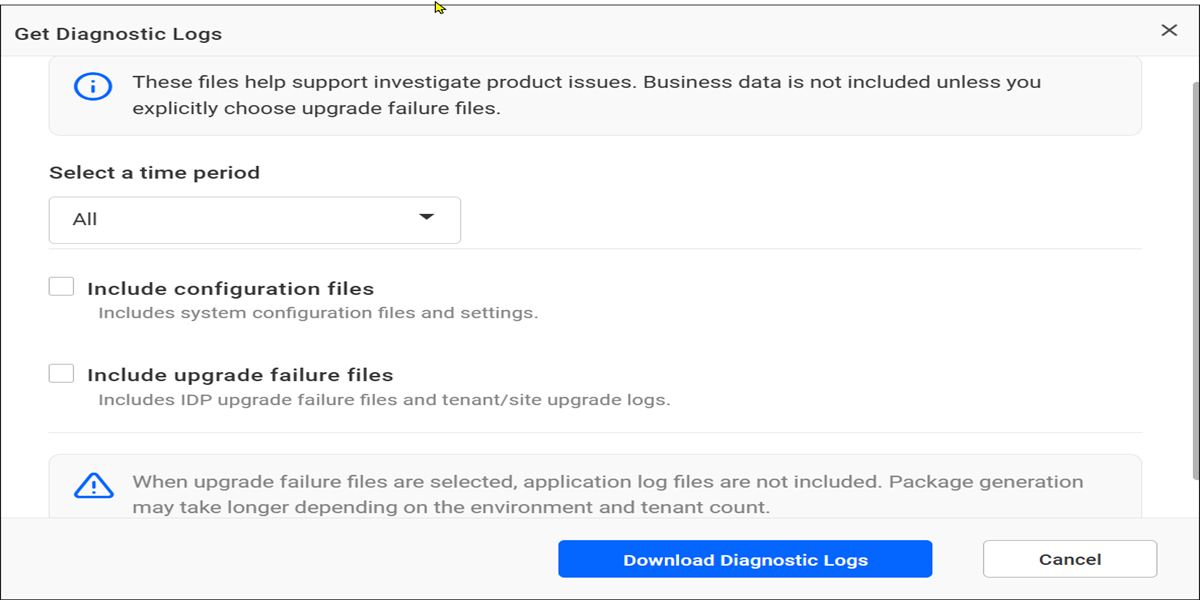
Note: If this notification banner is displayed, it indicates that the upgrade process encountered an issue. To resolve the issue, please contact us and share the upgrade-related logs with the support team for further investigation.
- Navigate to UMS > Sites, click the Help icon in the upper-right corner, and select Get Diagnostic Logs. Select Include upgrade failure files and click Download Diagnostic Logs to download the upgrade-related logs.