How do I set user and group permissions in Cloud Reporting?
Permissions in Bold Reports® control which users and groups can access specific resources, such as categories, data sources, datasets, reports, and schedules. They also control what those users and groups can do with the resources. Configuring permissions correctly keeps report data and connections available only to the people who need them.
The following sections describe the entities, scopes, and access modes that make up a permission. They also show how to add permissions for users and groups, and where to manage permissions after you assign them.
What is a permission
A permission in Bold Reports® has three parts. The entity is the type of resource being protected, and the scope is the specific resources the permission applies to. The access mode is what the user or group can do with that resource. Together, these form the structure Entity, Scope, and Access Mode, which determines exactly what a user or group can see and do on the server.
By default, all permissions are available to users in the System Administrator group, or to users designated with the permission entity of All Permissions. Users with the permission entity of Specific Permissions for a corresponding resource, such as Category, Data Source, Dataset, Report, or Schedule, can manage only the permissions related to that resource.
With permission management, you can
- Grant read, write, delete, download, or create access to categories, data sources, datasets, reports, and schedules.
- Apply a permission across all resources of a type, or scope it to specific resources only.
- Add permissions directly to individual users or to entire groups.
- Limit which administrators can manage which resource types through the
Specific Permissionsentity.
How permissions are built from entities, scopes, and access modes
In Bold Reports® Cloud, each permission combines an entity, a scope, and one access mode, and you can assign it directly to users or groups.
- Entities define the resource type: An entity identifies the type of resource a permission applies to. The following entities are available:
| Entity | Description |
|---|---|
| All Categories | Provides permission to access all categories with the chosen access mode. |
| All Data Sources | Provides permission to access all data sources with the chosen access mode. |
| All Datasets | Provides permission to access all datasets with the chosen access mode. |
| All Reports | Provides permission to access all the reports with the chosen access mode. |
| All Schedules | Provides permission to access all schedules with the chosen access mode. |
| Reports in Category | Provides permission to access reports in a specific category with a chosen access mode. |
| Specific Category | Provides permission to access a specific category with the chosen access mode. |
| Specific Data Source | Provides permission to access a specific data source with the chosen access mode. |
| Specific Dataset | Provides permission to access a specific dataset with the chosen access mode. |
| Specific Report | Provides permission to access a specific report with the chosen access mode. |
| Specific Schedule | Provides permission to access a specific schedule with the chosen access mode. |
- Access modes define what users can do: Access mode defines the actions a user or group can perform on the entity and scope you select.
| Access Mode | Description |
|---|---|
| Read | Provides read permission for the chosen entity. |
| Read and Write | Provides read and write permission for the chosen entity. |
| Read, Write, Delete | Provides read, write, and delete permission for the chosen entity. |
| Download | Provides download permission for the chosen entity. |
| Create | Provides permission to create the chosen entity. |
- Scope resources broadly or specifically: Scope selection is limited to the Specific Resources type, which lets you target one or more individual resources instead of an entire resource type. Adding permissions is divided into two sections:
- All Resources
- Specific Resources
NOTE: It is not possible to select multiple access modes for the same permission.
To assign multiple permissions across all resources, select multiple resource entities and one access mode.
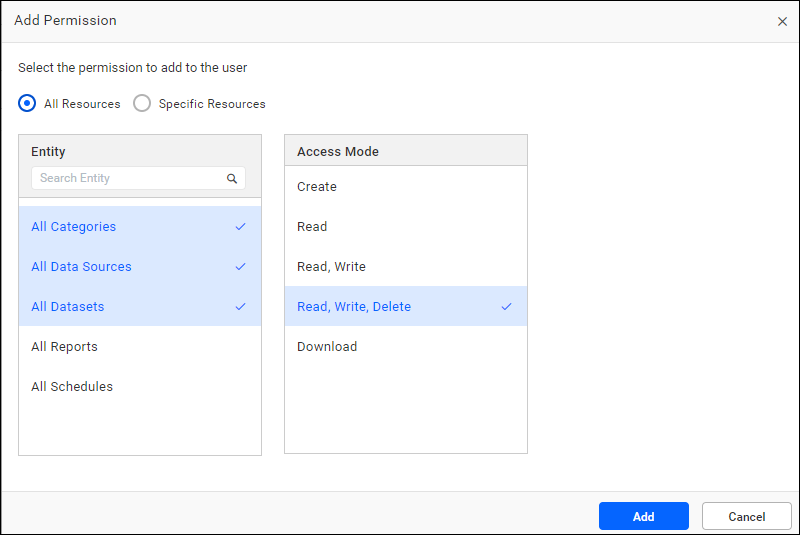
To assign multiple permissions for specific resources, select multiple scopes, one entity, and one access mode.
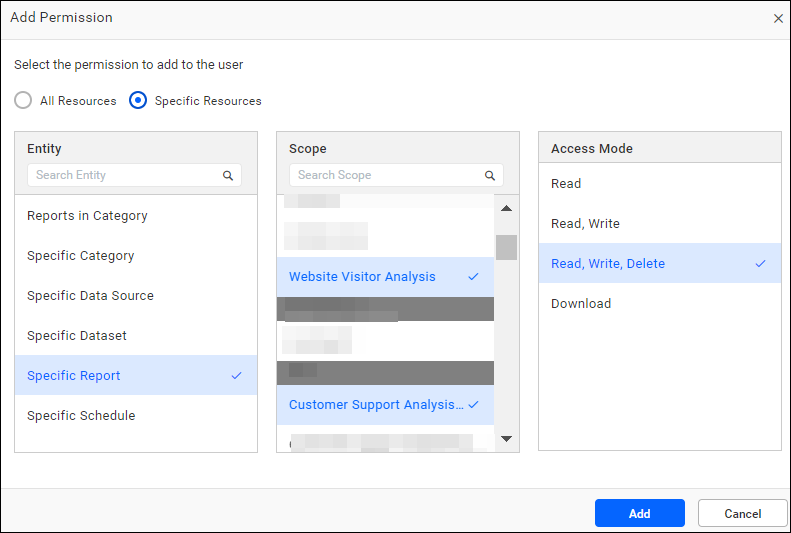
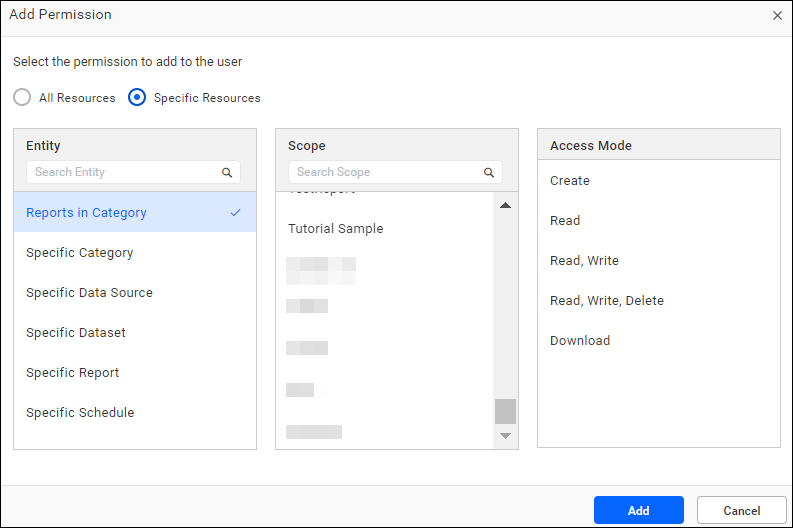
- Direct assignment to users and groups: Permissions can be added directly to both users and groups through the
Add Permissiondialog.
Common use cases
Administrators use permissions to restrict a single data source, give a team read-only access to a report category, delegate permission management, or allow downloads without edit access.
- Restricting access to a specific data source: Grant the Specific Data Source entity with Read access to a single connection. This avoids exposing every data source on the server to a user or group.
- Giving a team read-only access to a category of reports: Use the Reports in Category entity with Read access mode. The team can then view reports in that category but cannot edit or delete them.
- Delegating administration for a resource type: Assign the Specific Permissions entity for Data Source or Report to a lead user. That user can then manage permissions for that resource type without full System Administrator access.
- Allowing a group to download reports without editing them: Apply the Download access mode to All Reports or a specific report. The group can then export report output without gaining write or delete access.
Who should use this guide
Administrators, users who manage permissions for a resource type, IT teams, and report authors use this guide to set up or understand access to resources.
This guide is intended for:
- Administrators in the
System Administratorgroup who assign and audit permissions. - Users granted the
All PermissionsorSpecific Permissionsentity who manage access for a particular resource type. - IT teams setting up role-based access for users and groups.
- Report authors and business users who need to understand why they can or cannot access a resource.
Prerequisites
To manage permissions, you need an account in the System Administrator group, or one with the All Permissions entity or a relevant Specific Permissions entity.
Before you begin:
- You need access to the Bold Reports® Report Server with an account in the
System Administratorgroup, or one granted theAll Permissionsentity or a relevantSpecific Permissionsentity. - You need to know which users or groups require access, and to which categories, data sources, datasets, reports, or schedules.
- No additional software installation is required; permission management is available directly from the Report Server web interface.
Considerations and limitations
Each permission entry uses exactly one access mode, and a user’s access combines permissions assigned directly and through groups.
- You cannot select multiple access modes for a single permission entry; each entry uses exactly one access mode.
- Scope selection is limited to Specific Resources; use the All Categories, All Data Sources, All Datasets, All Reports, or All Schedules entities instead of a separate “all resources” scope value.
- A user can receive permissions both directly and through a group they belong to; the combined access from all sources applies.
- Only users in the
System Administratorgroup or holders of theAll Permissionsentity can manage permissions across every resource type.
FAQ
Can I assign multiple access modes to the same permission?
No. Each permission entry supports only one access mode. To grant a different level of access, add a separate permission entry.
Should I grant permissions to users or to groups?
Assigning permissions to groups is generally easier to maintain. When you add or remove a user from a group, their access updates automatically, so you do not need to change each user’s individual permissions.
Who can manage permissions for a specific resource type, such as data sources or reports?
Users in the System Administrator group, users with the All Permissions entity, and users granted the Specific Permissions entity for that resource type can manage permissions for it.
What happens if I remove a user from a group that has permissions?
The user loses any access that was granted through that group, but keeps any permissions that were assigned directly to them as an individual.
Where do I manage permissions for an existing user or group?
Use the Manage Permissions option from the user’s or group’s action menu, as described in the related articles below.
Can a user see a report or data source without read permission?
No. A user without read permission cannot see your data sources, datasets, or reports. Grant at least the Read access mode for the resource.
Getting help
If you need help configuring permissions, or you are not sure which entity, scope, or access mode fits your scenario, review the related articles below. You can also reach out through the Bold Reports® support channels on the Bold Reports® website.
Related articles
-
Manage User Permissions to add or update the permissions assigned to an individual user.
-
Manage Group Permissions to add or update the permissions assigned to an entire group.
-
Security overview to see how permissions fit with authentication and tenant isolation.
-
Manage categories to organize the reports that category permissions apply to.