Linear gauge in Bold Reports® Web Report Designer
In the Bold Reports® Web Report Designer, a linear gauge is a rectangular report item oriented horizontally or vertically. You can place a linear gauge inside the Tablix and Matrix report items.
How do I add a linear gauge to the report?
You add a linear gauge to a Bold Reports® report by dragging it from the item panel into the design area.
- Find the linear gauge report item in the item panel under the
Deviationcategory.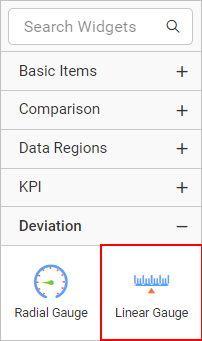
- Drag the linear gauge report item into the design area from the item panel.
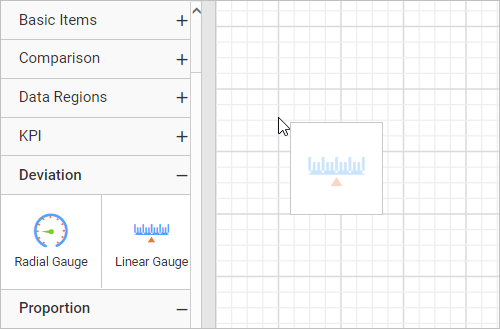
- Drop the linear gauge item in the design area. The properties panel then lists the item properties.
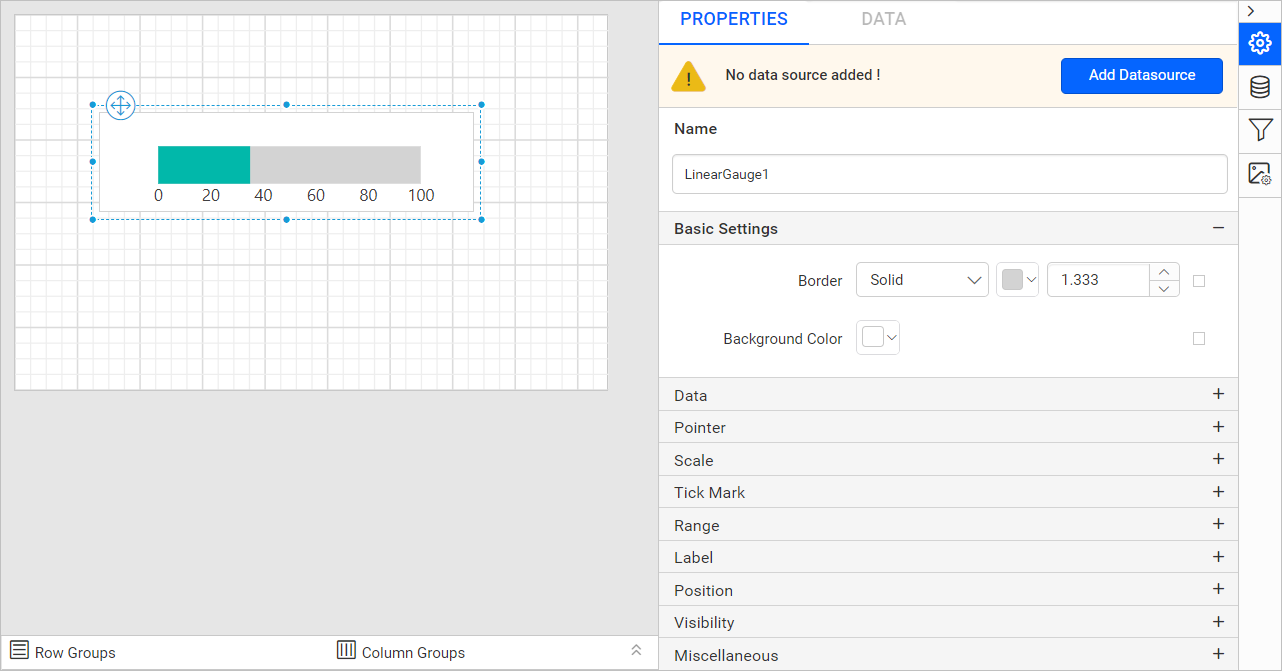
Which properties can I set for a linear gauge?
The Bold Reports® properties panel lists every linear gauge property described below. Read the Properties panel section before you work with the following properties.
Basic settings
The border style, color, width, and background color properties customize the appearance of a linear gauge in the report design. The properties panel lists these properties under the Basic settings category.
Border
Border properties add or customize the border around a linear gauge item to visually separate items in the report design. To set border properties for a linear gauge item in the properties panel, see the Border Properties section.
Background color
The background color property customizes the background color of a linear gauge. To set the background color in the properties panel, see the Background color section.
Data
The Data category of the linear gauge holds the dataset, type, value, range, and interval properties.
Dataset
The Dataset property assigns a dataset to a linear gauge report item. The Dataset property dropdown lists the available datasets in the report. Choose the dataset you want from the dropdown.
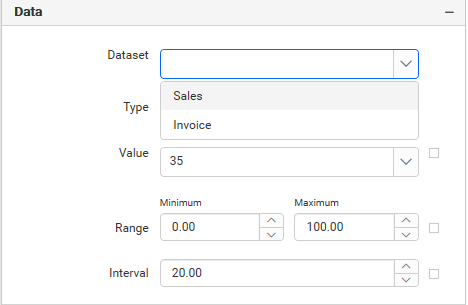
To add a dataset to your report, see the Create Data section.
Type
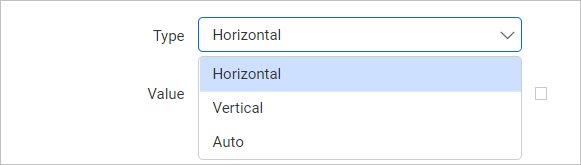
The Type property selects the type of linear gauge report item. You can select Horizontal, Vertical, or Auto from the dropdown.
-
Horizontal: Displays the linear gauge horizontally. -
Vertical: Displays the linear gauge vertically. -
Auto: Displays the linear gauge according to the width and height of the linear gauge.
Value
The Value property assigns the pointer value of a linear gauge. You can also set the pointer value based on dynamic values by using expressions.
Range
The Range property assigns the minimum and maximum values of a linear gauge. You can also set the minimum and maximum values based on dynamic values by using expressions.
Interval
The Interval property assigns the interval value between the scale labels. You can also set the interval value based on dynamic values by using expressions.
Pointer
The Pointer properties customize the pointer placement, type, marker style, marker length, width, and color in the linear gauge design.
Enable pointer
To show or hide the pointer in a linear gauge, toggle the Enable Pointer checkbox.
Placement
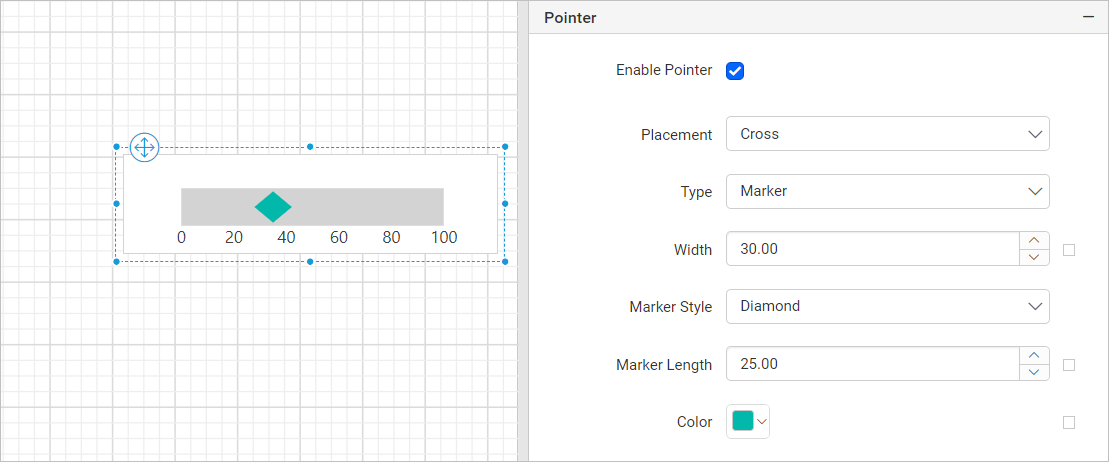
Linear gauge pointer placement can be Inside, Outside, or Cross. Select a placement from the dropdown.
Type
The pointer Type property sets the pointer to Marker or Bar. Select the type from the dropdown. If you select the Marker option, the Marker Style and Marker Length properties appear in the properties panel.
Marker style
The Marker style property sets the shape of a marker pointer. Select Circle, Rectangle, Triangle, or Diamond from the dropdown.
The following image shows a linear gauge with the Marker pointer type, Diamond marker style, and Cross pointer placement.
Marker length
The Marker length property assigns the pointer marker length value. You can also set the marker length based on dynamic values by using expressions.
Width
The pointer Width property assigns the pointer width value. You can also set the width based on dynamic values by using expressions.
Color
The pointer Color property customizes the pointer color of a linear gauge.
Scale
The Scale properties set the width, color, direction, and labels of the linear gauge scale.
Width
The scale Width property assigns the scale width value. You can also set the width based on dynamic values by using expressions.
Color
The scale Color property customizes the scale color of a linear gauge.
Reverse direction
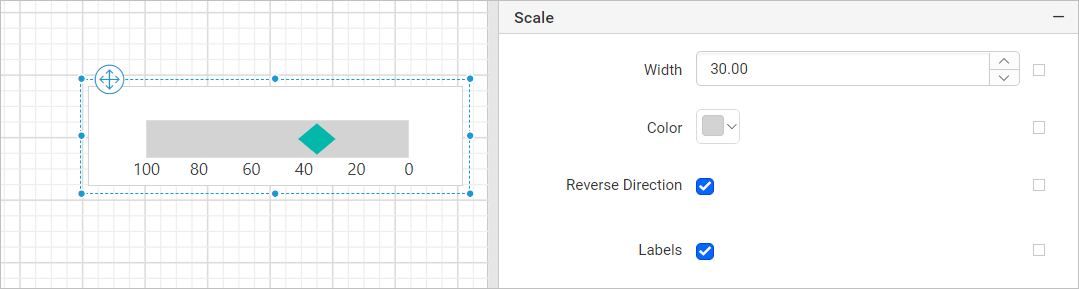
The Reverse direction property reverses the linear gauge scale direction from maximum to minimum. To turn it on, select the Reverse Direction checkbox.
Labels
To show or hide the scale labels in a linear gauge, toggle the Label checkbox.
You can customize the scale label in the Advanced Options menu. To open and handle the nested properties of labels, see the Advanced Properties section.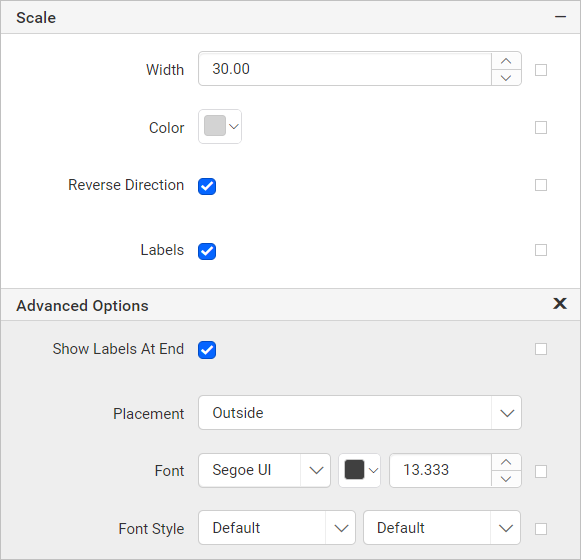
These properties customize the scale label font color, font family, font size, and font style in the linear gauge design.
Show labels at the end
To show or hide the scale labels at the end of the scale, toggle the Show Labels At End checkbox.
Placement
Scale label placement can be Inside, Outside, or Cross. Select an option from the dropdown.
Tick mark
The Tick mark property customizes the major and minor ticks of a linear gauge.
Major tick and minor tick
To show or hide major and minor ticks in a linear gauge scale, toggle the Major Tick and Minor Tick checkboxes.
You can customize major and minor ticks in the Advanced Options menu. To open and handle the nested properties of major and minor ticks, see the Advanced Properties section.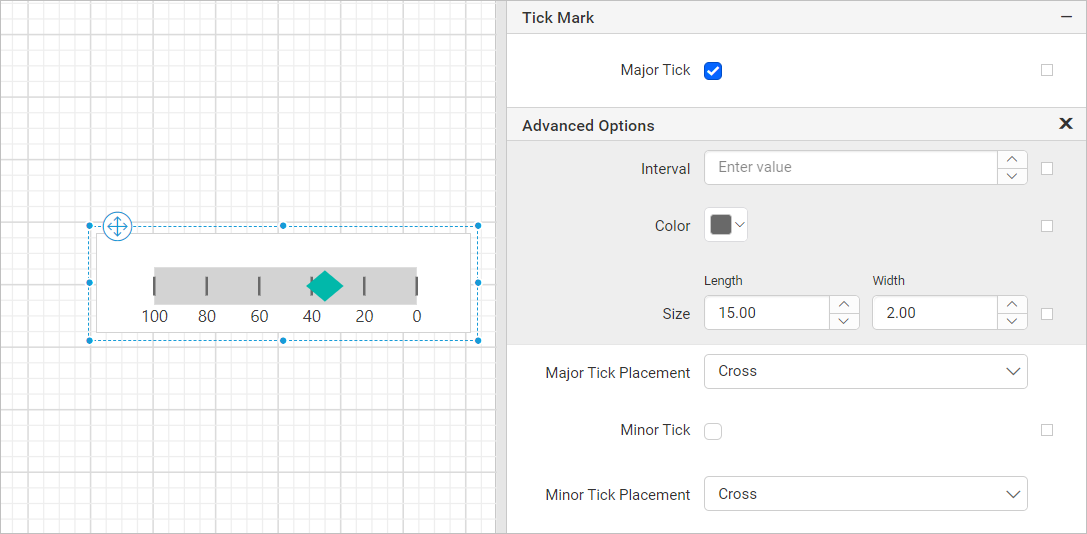
These properties customize the major and minor tick interval, color, length, and width.
Major tick placement and minor tick placement
Linear gauge major tick and minor tick placement can be Inside, Outside, or Cross. Select the placement from the dropdown.
Range
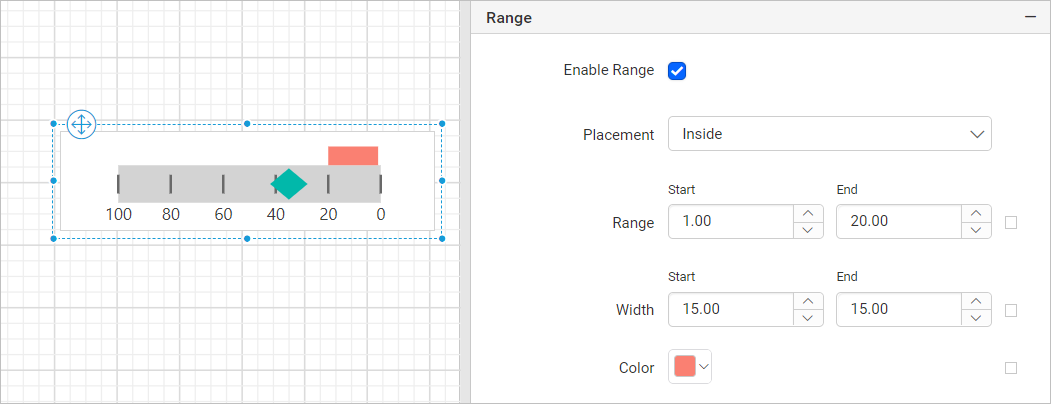
The Range properties customize the range placement, start value, end value, start width, end width, and color in the linear gauge design.
Enable range
To show or hide the range in a linear gauge, toggle the Enable Range checkbox.
Placement
Linear gauge range placement can be Inside, Outside, or Cross. Select an option from the dropdown.
Range
The range property assigns the range start and end values of the linear gauge. You can also set the start and end values based on dynamic values by using expressions.
Width
The range Width property assigns the range start width and end width values of the linear gauge. You can also set the start and end width values based on dynamic values by using expressions.
Color
The range Color property customizes the range color of a linear gauge.
Position
The position property sets the width, height, left, and top positions of a linear gauge in the report design. To set these properties in the properties panel, see the Position section.
Link
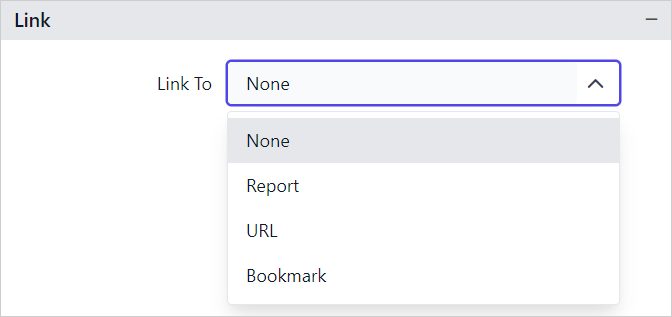
The Linking property in Bold Reports® lets you create interactive, user-friendly reports by adding actions such as Hyperlink and Report Linking. To learn more, see the Linking section.
Data Element
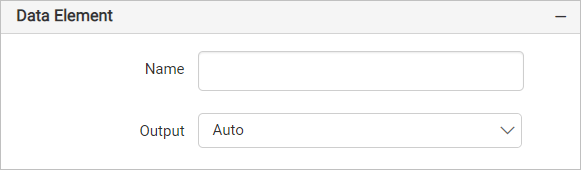
The Data element properties control the visibility of a linear gauge when you export the report in XML format. The properties panel lists these properties under the Data Element category.
Name
Use the Name field to assign a custom name to the linear gauge element. The linear gauge is exported with the name you provide.
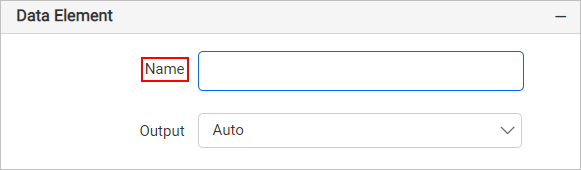
Note: The name cannot contain spaces, and it must begin with a letter followed by letters, numbers, or the underscore character (_).
Output
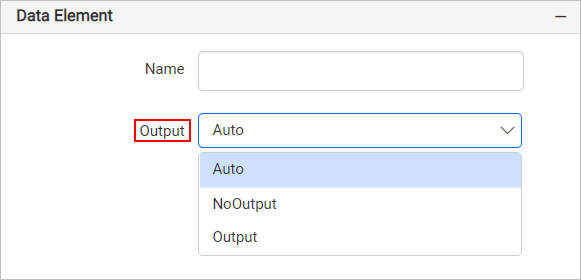
The Output property controls the visibility of the linear gauge when you export the report. Each option performs the following operation:
- Auto or Output: Exports the linear gauge report item.
- NoOutput: Does not export the linear gauge report item.
Visibility
The visibility property conditionally shows or hides the linear gauge report item on report preview or export. To set the visibility of a linear gauge item in the properties panel, see the Visibility section.
Miscellaneous
The Miscellaneous category holds the page name, document map, bookmark, custom attributes, and custom style properties of the linear gauge.
Page name
The page name property names the first worksheet of the Excel workbook when you export the report to Excel format.

You can set static or dynamic text as the page name. To set and reset dynamic text, see the Set Expression and Reset Expression sections.
Document Map
A document map is a navigational feature that displays a separate side pane with a set of navigational links in a hierarchical structure when you view a report. Users click an entry in the list to navigate to the report page that displays that item. To configure a document map in the report design, see the Document Map section.
You can set static or dynamic text as the value of the document map property. To set and reset dynamic text, see the Set Expression and Reset Expression sections.
Bookmark
Bookmark links let users navigate to different parts of an SSRS report. You can add bookmarks to each textbox, image, table, or chart, or to the unique group values displayed in a tablix, to direct users to specified locations in the report. The bookmark value can be your own string or an expression. To configure a bookmark in the report design, see the Bookmark section.
You can set static or dynamic text as the value of the bookmark property. To set and reset dynamic text, see the Set Expression and Reset Expression sections.
Custom attributes
The custom attributes property sets the values of linear gauge custom properties. To assign values to custom properties in the properties panel, see the Custom Properties section.
Tooltip
The Tooltip property displays informative text or a value when the user hovers over the report item in report preview. To set a tooltip for the gauge report item in the properties panel, see the Tooltip section.
Custom Style
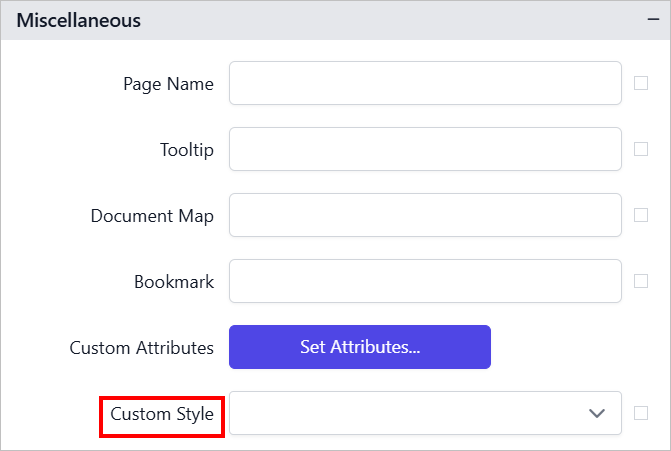
The Custom Style property lets you use external CSS to style report items, giving more flexibility than the built-in styling options. Use this property to meet specific design requirements and keep styling consistent across multiple reports. For a step-by-step guide on setting up custom styles in your report, see the How To section of this guide.
Frequently asked questions
Where can I place a linear gauge?
You can place a linear gauge in the report design area, and also inside the Tablix and Matrix report items.
Which pointer types does the linear gauge support?
The linear gauge supports the Marker and Bar pointer types. The Marker type adds the Marker Style and Marker Length properties.