Query Execution Policy
Query Execution Policy in Bold Reports® is a combination of Security Policy and Permission Policy. Together, these policies control, validate, and secure query execution within the application, protecting your data by enforcing strict server-level rules. Enabling Query Execution Policy helps administrators ensure only approved queries are run, mitigating risks of data breaches and privilege escalation.
How Query Execution Policy Works
When enabled, Query Execution Policy validates incoming queries using both high-level permissions and granular command restrictions. Each query is checked in a specific order against a range of policy nodes to decide whether it should be executed, blocked, or flagged for review.
How to Configure Query Execution Policy
Configuration for Query Execution Policy is performed via the Bold Reports® UMS Admin interface.
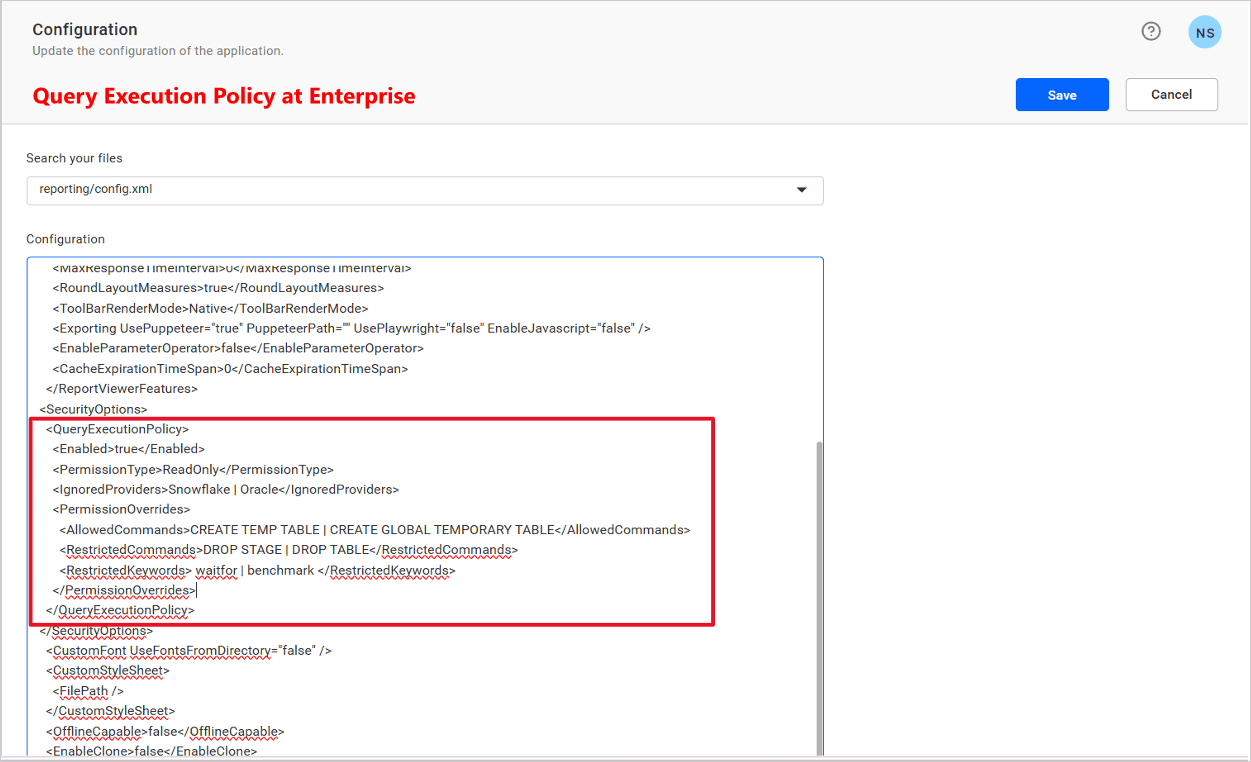
Query Execution Policy
1. Enabled
- Purpose: Globally toggle Query Execution Policy validation for all incoming queries.
- Behavior when enabled: All configured policies are enforced. Unauthorized or non-compliant queries will be blocked with a validation message.
- Behavior when disabled: Server will NOT enforce any Query Execution Policy. Queries are executed as usual, without restriction.
2. Permission Types
- Overview: Defines the base set of commands and actions permitted to execute across the system.
- Effect: Determines whether query execution is restricted to ReadOnly, ReadWrite, or Unrestricted commands. See Permission Types for detailed breakdowns.
3. Ignored Providers
- Purpose: Specify data providers or sources that should bypass Query Execution Policy checks for special scenarios. If a data provider is listed here, both Security Policy and Permission Policy will not be enforced for those sources See Supported Providers.
- Configuration: Set provider names or connection identifiers to ignore in policy settings.
4. Permission Overrides
- Defines global command restrictions and allowances configured in UMS that apply across the Query Execution Policy. Permission overrides do not bypass Security Policy under any circumstances.
- Includes Restricted Commands, Restricted Keywords, and Allowed Commands. See Permission Overrides for detailed configuration options.
Query Evaluation Order
Queries are validated in the following order, with security protections enforced first:
- Dangerous Commands: Blocked immediately if the query contains any dangerous commands. See Dangerous Commands for detailed breakdowns.
- Injection Patterns: If the query matches a known dangerous injection pattern, it is blocked. See Injected Patterns for detailed breakdowns.
- Restricted Commands: Blocked if the query contains any restricted commands, regardless of permission type.
- Restricted Keywords: Blocked if the query contains any restricted keywords.
- Allowed Commands: The query is permitted if it only uses allowed commands (unless blocked for security reasons).
- Permission Types: The configured Permission Type (ReadOnly, ReadWrite, Unrestricted) is evaluated last; if the command is permitted by type, it is allowed unless blocked above.
Supported Providers
These are the supported providers for Query Execution Policy:
Dataconnectors: SQL, MySQL, Oracle, PostgreSQL, SSAS, Snowflake, GoogleBigQuery, ODBC, Oledb