How do I create a shared data source in Cloud Reporting?
In Bold Reports® Cloud, a data source is a saved connection to a database or service that a report uses to retrieve data. Creating a data source once and storing it on the Report Server saves you from re-entering connection details every time you build a new report.
This page explains how to add, update, edit, and delete shared data sources in the Report Server, and how permissions control who can manage them. Use it whenever you need to connect reports to a database or service in a centralized, reusable way.
Understand shared data sources
When you create or upload a data source to the Report Server, it becomes a shared data source. The shared data source is stored on the Data Sources page and is available to any report that needs it, subject to the user’s permissions. This is different from a data source defined inside a single report, which only that report can use.
Using shared data sources instead of embedding connection details in individual reports is recommended practice. Shared data sources centralize credential management. When server details change, you update the connection in one place. Permissions are enforced at the data source level, which keeps report-level access more secure.
With data sources management, you can
- Create a shared data source from a range of supported connection types, including a connection string or a Web API.
- Create a dataset directly from a new or existing data source.
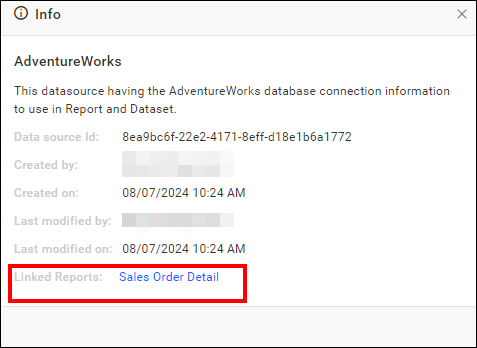
- View data source details, such as who created or last modified it and which reports use it.
- Edit a data source’s raw XML definition without downloading it.
- Update connection and credential details for an existing data source.
- Delete a data source that is no longer needed.
Key features
Data source management centralizes connections, supports multiple data source types, controls access by permission, and lets you edit definitions as XML.
- Centralized connection management: Shared data sources live in one place on the Report Server. You make a connection change once instead of in every report that uses it.
- Multiple data source types: The Report Server supports creating a data source from common relational databases, other supported connectors, and Web APIs. You choose how reports connect to data.
- Permission-based access control: Creating, updating, downloading, and deleting a data source each depend on the acting user’s permissions, so administrators can control who is allowed to manage shared connections.
- Direct XML editing: The built-in XML editor lets you modify a data source’s definition directly in the browser, without downloading the file and editing it in a separate text editor.
Common use cases
Teams use shared data sources to standardize report connections, rotate credentials in one place, check linked reports before changes, and build new reports faster.
- Standardizing report connections across a team: Report authors across a team can connect to the same shared data source instead of each configuring their own, keeping connection details consistent.
- Rotating credentials without editing every report: When a database password or connection string changes, update the shared data source. The change applies to every report and dataset that depends on it.
- Auditing data access before making changes: Before you edit or delete a data source, review its info panel to see which reports are linked to it. This check helps you avoid breaking those reports.
- Building new reports quickly from existing connections: Report authors can create a new dataset directly from an existing data source. They do not need to re-enter connection details for each new report.
Who should use this guide
Report authors, administrators, developers, and IT teams who work with shared data sources use this guide:
- Report authors who need to connect reports to a database or service.
- Administrators responsible for managing server-wide data connections and permissions.
- Developers integrating data source management into automated workflows through the REST API.
- IT teams auditing which reports depend on which data connections.
Prerequisites
Before you manage data sources, make sure you have the following:
- You need access to the Report Server with an account that has the relevant data source permission, such as
Create All Data Sources, for the action you want to perform. - You need the connection details for the database or service you want to connect to, such as the server name, authentication type, and database name.
- No additional software installation is required; data source management is available directly from the Report Server web interface.
How to manage data sources
You manage shared data sources on the Data Sources page of the Report Server, where you can create, view, edit as XML, update, and delete them.

Add or create data sources
A data source can be added to the Report Server only if the user has the Create All Data Sources permission.
-
Click the
Create Data Sourcebutton on the Data Sources listing page.
While adding a data source, you can also add a new dataset to the Report Server using either the
Create New Datasourceoption or theUse existing Datasourceoption. -
Keep Create New Datasource selected, and then select the data source type to connect to.

Note: Bold Reports® also supports creating a data source using a
Web API. -
Enter the name and description of the data source. Then provide the server name and authentication type, and select the database.

You can also create a data source using a connection string by clicking the advanced options.

-
Click
Save and Create Datasetto create a new dataset connected to the newly created data source. -
Enter the name and description of the dataset, then click
Proceed to Query Designer.
-
After designing the dataset, click
Save.Read, Write, Delete, Downloadpermission for theSpecific Data Sourceis added automatically for the user who created the data source.
View data source information
The Info option in the data source Actions menu shows the data source ID, creation and modification details, and linked reports.
-
Click the
Actionsmenu button in the data source grid context menu and selectInfo.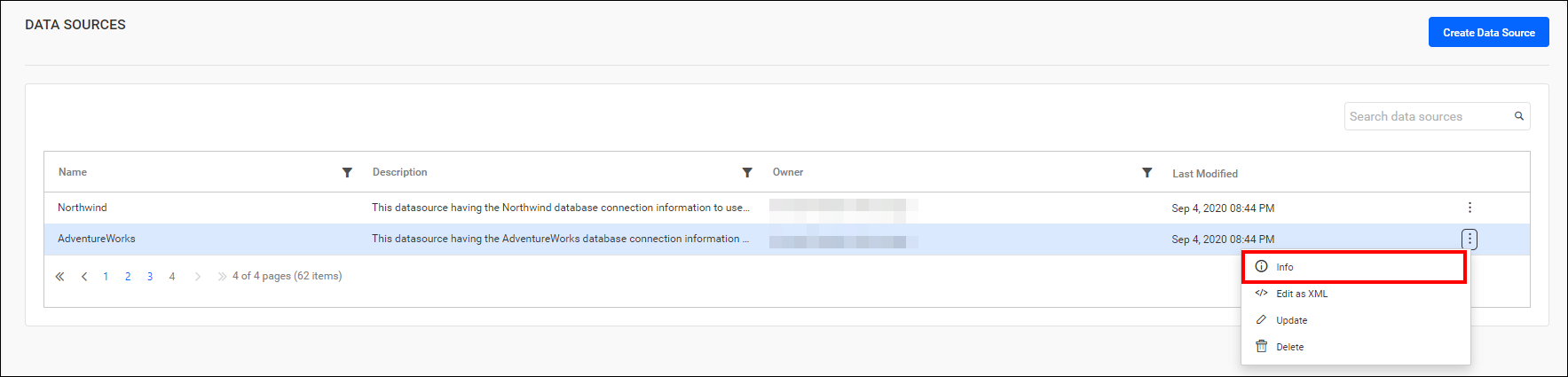
-
The data source
Infoaction shows the data source ID, who created it, when it was created, who last modified it, when it was last modified, and its linked reports.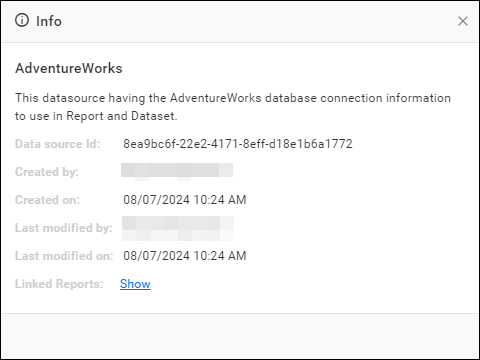
-
Click
Showto view the linked reports.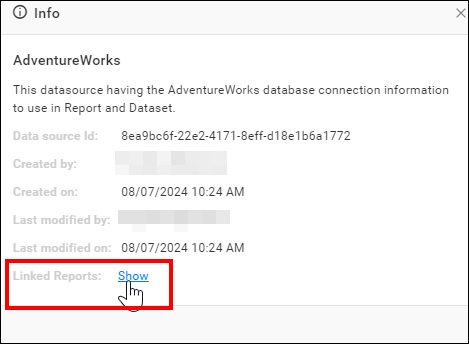
Edit a data source as XML
The XML editor provides a user-friendly interface for making changes to a data source directly in the Report Server, without downloading it and using a separate text editor.
-
Click the
Actionsbutton in the data source grid context menu and selectEdit As XML.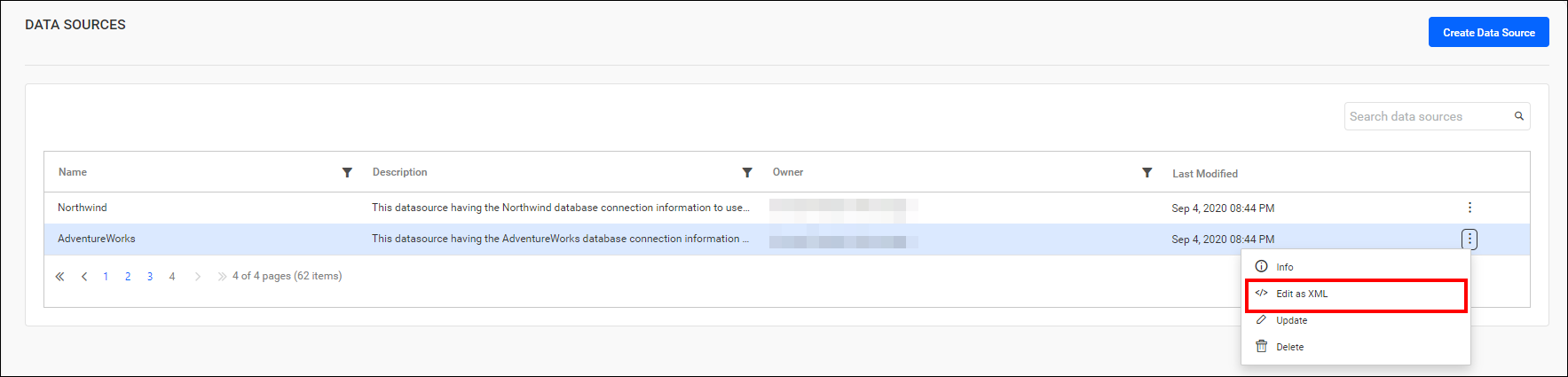
-
The data source opens in a new tab as XML, where you can make changes and save them by publishing the edited data source from the XML editor.

Update a data source
You change a data source’s name, description, type, connection string, and credentials with the Update option in the data source Actions menu.
-
Click
Actionsin the data source grid context menu and selectUpdate.
-
In the
Updatedialog, you can change the name, description, data source type, connection string, and credential details used to connect to the data source.
This option is available in Bold Reports® On-Premises Edition from version
2.2.28.
Delete a data source
You delete a data source that is no longer needed from the data source Actions menu, as long as no report uses it.
Click the Actions button in the data source grid context menu and select Delete.

A data source cannot be deleted if a report uses it.
Considerations and limitations
Before you change data sources, note these limits on deletion, XML editing, version-specific options, and permissions:
- A data source cannot be deleted while any report still uses it. Remove or reassign those reports first.
- Editing a data source as XML requires care, since incorrect XML can break the connection for every report that relies on it.
- Update and XML-editing options may vary by Bold Reports® edition and version; some options, such as the
Updateaction, were introduced in a specific On-Premises Edition release. - Permissions are evaluated per action (create, update, download, delete), so a user may be able to view a data source without being able to modify it.
FAQ
What is the difference between a shared data source and a report-specific data source?
A shared data source is stored on the Report Server and can be reused by multiple reports and datasets. A data source defined inside a single report is only available to that report.
Can I see which reports use a specific data source before deleting it?
Yes. Open the data source’s Info panel from the Actions menu to view its linked reports before making changes.
Do I need to download a data source to edit its connection details?
No. You can update most connection and credential details directly from the Update dialog, or make deeper changes using the built-in XML editor, without downloading the file.
Why can’t I delete a data source?
A data source cannot be deleted while it is still linked to one or more reports. Remove those dependencies first, or reassign the reports to a different data source.
Can I manage data sources programmatically instead of through the UI?
Yes. The REST API Reference below lists the available endpoints for adding, updating, retrieving, and deleting data sources.
How does Cloud Reporting connect to a database on my own network?
Cloud Reporting connects to a remote database only when your firewall allows inbound connections from the Cloud Reporting IP addresses. The current addresses are listed in IP addresses to whitelist for remote database access.
Which data source types can I use?
You can create a data source from relational databases, other supported connectors, and Web APIs. See Data connectors for the supported connectors.
Getting help
If you run into an issue managing data sources, check the REST API Reference below for programmatic options, or review the related articles for dataset creation and permission management. For further assistance, reach out through the Bold Reports® support channels available on the Bold Reports® website.
Related articles
-
Dataset management in Report Server to create and manage datasets built from your shared data sources.
-
Report parts to reuse report items, such as datasets and data sources, across multiple reports.
-
Manage Resources for an overview of how reports, datasets, and data sources are organized on the Report Server.
-
Manage permissions to grant data source permissions such as
Create All Data Sourcesto users and groups. -
IP addresses to whitelist for remote database access before you connect to a database behind a firewall.
REST API Reference
The following table lists the available APIs related to data sources.
| Action | HTTP Method | Endpoint | Description |
|---|---|---|---|
| AddDataSource | POST | /api/site/{tenant-name}/v1.0/reports/data-sources | Adds a new datasource to the server. Datasource details must be passed as input. |
| UpdateDataSource | PUT | /api/site/{tenant-name}/v1.0/reports/data-sources | Updates the datasource in the server. Updated datasource details must be passed as input. |
| GetDataSources | GET | /api/site/{tenant-name}/v1.0/items | Returns the list of datasources for current user. ItemType should be Datasource. |
| GetDataSourceLocation | GET | /api/site/{tenant-name}/v1.0/items/{itemId}/location | Returns the item location of the specified datasource. Specific DataSource ID should be passed in path parameter. |
| IsDataSourceNameExists | POST | /api/site/{tenant-name}/v1.0/items/is-name-exists | Returns an item existence whether the given datasource name already exists or not in server. Datasource name and ItemType as DataSource should be passed in request body. |
| GetDataSourceDetail | GET | /api/site/{tenant-name}/v1.0/items/{id} | Returns the specified datasource details from the server. DataSource item ID should be passed in path parameter. |
| DeleteDataSource | DELETE | /api/site/{tenant-name}/v1.0/items/{id} | Deletes the specified datasource from the server. DataSource item ID should be passed in path parameter. |